


Home > “Picture Palace” > The World > Theaters
Picture palaces– a.k.a. movie palaces– were the luxury theaters of their time. In their heyday, architects and owners kept trying to outdo each other with bigger, fancier, and more opulent buildings. These theaters were often local landmarks and longtime watering holes. A lot of them are long-gone by now, and only a handful still show movies today. Even so, these buildings have come to epitomize the beauty and the romance of old Hollywood.
Before the late 1800’s, fancy theaters had catered mostly to the upper classes, like London’s Prince Albert Hall and Paris’s Opéra Garnier. Over time, though, American theaters started to take a different tack. Chicago’s Auditorium Building was one of the first designed to bring high culture to the masses: it had no box seats, and every seat had an unobstructed view of the stage.
Silent movies appeared in the late 1890’s. At first, they were usually shown as part of vaudeville shows. Purpose-built movie theaters didn’t appear till around 1905. These “nickelodeons” were cheap little buildings, often in converted storefronts. But as movies became more and more popular, their theaters got to be bigger and bigger.
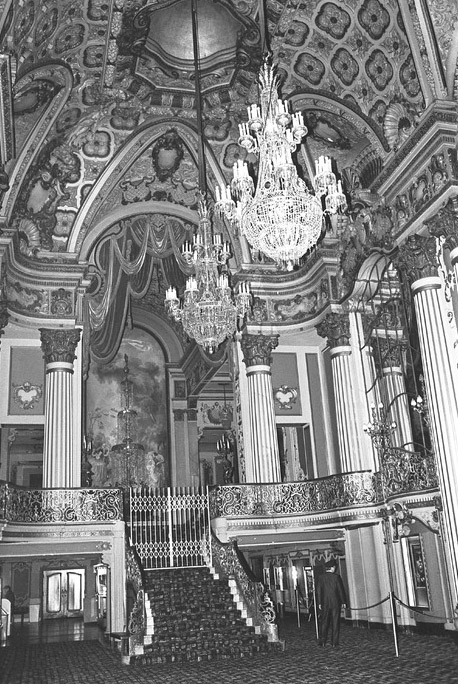
Photo credit: © UCLA Library/L.A. Times Photographic Archive
A lot of these theaters were modeled after opera houses. They often used a mishmash of different architectural styles, from French to Chinese to Egyptian to nearly everything in between. Many included fountains, ballrooms, and other amenities. Some theater owners became famous in their own right, like New York’s “Roxy” Rothafel, who built Radio City Music Hall; or L.A.’s Sid Grauman, who built his namesake Chinese Theatre. “Atmospheric theaters” had ceilings designed to look like the night sky (like the Majestic in Dallas or the Fox in Atlanta). “Courtyard theaters” actually did put their audiences under the sky, with open-air courtyards serving as their lobbies (like the Alex in Glendale, California, or the Egyptian in Hollywood).
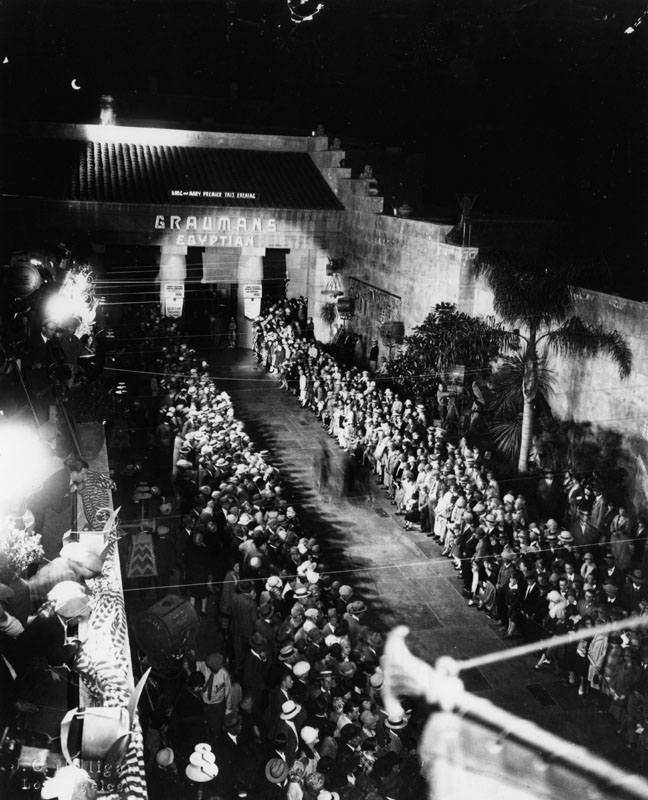
Photo credit: LAPL/ Security Pacific National Bank Collection
Some theaters managed to hang on till the 1970’s or 80’s. In many cases, they had to resort to “blaxploitation” or other racial/ethnic niches to stay in business. Some theaters even switched to showing pornography. When multiplexes came into fashion, nearly all the remaining palaces died out. Some of them survived by converting to stage plays (like Chicago’s eponymous Chicago Theatre) while others became community gathering places (like San Francisco’s Castro).
In other ways, though, the business eventually came full-circle. By the 2000’s, new luxury theaters were coming on the scene. Like their earlier counterparts, they promised to pamper their customers. They competed for amenities like state-of-the-art picture and sound, reserved seating, and so on. Meanwhile, a lot of downtowns have gentrified, and historic preservation laws have also improved; so a lot of old theaters have gotten a new lease on life.
Home > “Picture Palace” > The World > Theaters
News – Contact – Credits – Site Map
 Peter J. Spalding