


Home > “Picture Palace” > The World > Hollywood
The movies weren’t originally based in Los Angeles. In fact, the industry was arguably born in Europe. The first motion picture (albeit a primitive one) was made in England in 1888. The first film screenings with a paying audience were in Paris and Berlin in 1895.
In those days, Hollywood wasn’t much more than a frontier outpost. Even so, it didn’t take long before the industry came calling, and by the 1920’s, L.A. was the entertainment capital of the world.
(By the way, technically Hollywood is just a small part of L.A., and most studios have always been based in other parts of the city. But even in its early years, Hollywood became closely associated with the movies, so its name became synonymous with the business.)

Legal disputes also played a big part. In the early 1900’s, Thomas Edison tried to monopolize the industry. He and his “Edison Trust” claimed to own the patents for nearly all film cameras, projectors, and even the film stock itself. They sued anyone who made movies without their permission, and they even sent enforcers to destroy filmmakers’ equipment. Edison’s home base was in New York and New Jersey, so his competitors stayed as far away as possible. Southern California was ideal; apart from its sheer distance, it also allowed filmmakers to flee into Mexico if needed. Edison eventually lost in court, so the trust fell apart. The California-based studios were the ones left standing, and they soon dominated the business.
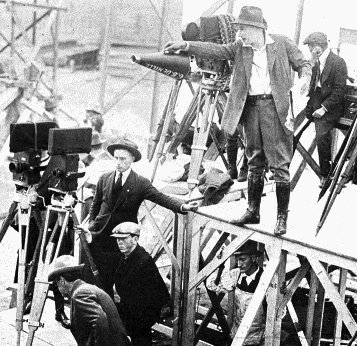
Of course, once Hollywood had become such a powerhouse, it became an attraction in its own right. By the 1920’s, L.A. drew in countless tourists who wanted to see where the magic happened. More importantly, the city became a magnet for actors, writers, musicians, technicians, and anyone else who wanted to make it in the business. All of these people have left their mark, and they’ve since turned the city into a major metropolis. By some estimates, L.A. is now home to more creative professionals than any other city in history.
Home > “Picture Palace” > The World > Hollywood
News – Contact – Credits – Site Map
 Peter J. Spalding