


Home > “Picture Palace” > The World > 1950’s
The 1950’s weren’t necessarily as uptight and conservative as people assume. In Los Angeles, it was a time of upheaval, one of the most dramatic in the city’s history. In a lot of ways, those years shaped the city we see today.
For one thing, the movie business was being turned upside down. In the 1930’s and 40’s, Hollywood had run under the old studio system. Most actors, writers, and other creative talent were under long-term contracts; they had little or no say over which films they worked on, because the studios just gave them assignments. This did give employees job security, but a lot of them complained about having to work on low-quality films. In 1944, Olivia De Havilland won a landmark court ruling that threw out her contract. In 1948, the U.S. Supreme Court ruled that the studio system violated antitrust laws. As fate would have it, that was just when the new medium of television appeared on the scene, so moviegoing dropped dramatically.
By the 1950’s, the old studio system was crumbling. M.G.M. head Louis B. Mayer, who had been the undisputed king of Hollywood, was fired from his own company in 1951. Studios stopped writing long-term contracts, and started hiring people for just one film at a time. A few filmmakers did start working in television– most notably Alfred Hitchcock and Walt Disney– but many others struggled in this uncertain world.
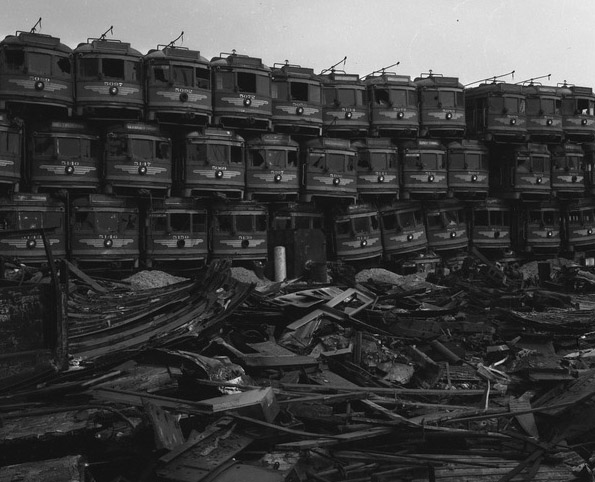
Photo credit: © UCLA Library/L.A. Times Photographic Archive
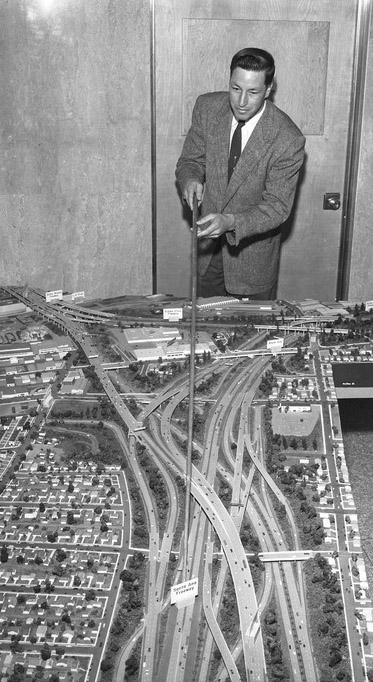
Photo credit: © UCLA Library/L.A. Times Photographic Archive
Along with that came smog. L.A.’s first big smog attack happened in 1943, but at first, the city assumed it was just pollution from a factory. It wasn’t till the mid-1950’s that officials recognized auto exhaust was to blame. By then, the problem had reached crisis levels. It took decades to bring the smog under control through strict pollution regulations and cleaner-burning engines.
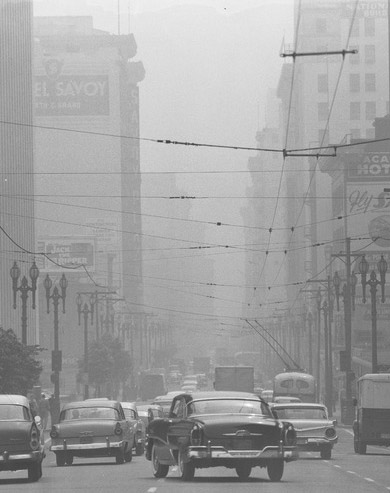
Photo credit: © UCLA Library/L.A. Times Photographic Archive
Of course, none of these changes lasted forever. By the 1970’s, the film and T.V. industries had learned to co-exist; they got back on their feet financially with Jaws, Star Wars, and the other blockbusters that followed. Around the same time, “freeway revolts” slowed and later stopped new freeway construction. Eventually the rail system came back to life; the modern L.A. Metro is much smaller than its predecessors, but it uses a lot of the same routes, and it is steadily expanding. By the 2000’s, downtown was gentrifying, and today it’s the hot new place to be.
Still, in retrospect, the 1950’s were L.A.’s formative years. They saw the city outgrow its old role as a glorified resort town, and grow into its new role as a major metropolis. In many ways, those years shaped the city more than any other decade, before or since– so they’re largely why L.A. is what it is to this day.
Home > “Picture Palace” > The World > 1950’s
News – Contact – Credits – Site Map
 Peter J. Spalding